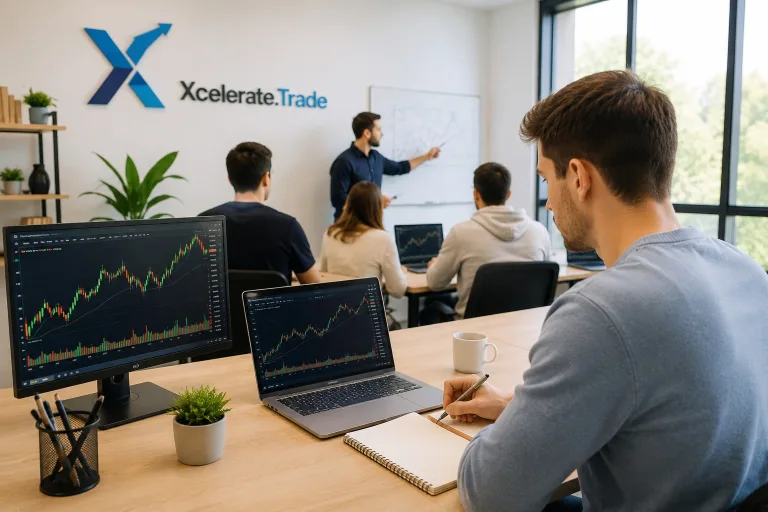
Why could Xcelerate Trade appeal to traders beyond the crypto niche
Job ticket
- Section
- Crypto And Trading
- Sheet
- 101
- Printed
- Reading time
- 14 min read
Information checked on
Why would Xcelerate trade appeal to traders who don't trade crypto?
Xcelerate Trade teaches a trading method rather than a single asset, so its academy, replay and demo practice, strategies and marketplace apply to forex, futures, stocks and indices as well as crypto. Its core habits, sizing positions from the stop and keeping a trade journal, work the same on any chart.
Key points
- Xcelerate Trade's homepage names forex, futures, stocks and crypto, and its strategies catalog adds indices and spot markets.
- Position sizing from the stop loss works the same way on a currency pair, a stock index CFD and Bitcoin.
- The opening range breakout setup featured in the catalog was described by Toby Crabel in 1990 for stock index and futures day trading.
- The Practice section lists demo trading, replay mode, challenges, prop evaluations and competitions.
- The first two academy chapters are free, and the access page says no identity KYC is required to learn.
- According to the BIS, forex turnover averaged $9.6 trillion a day in April 2025.
- ESMA cited data showing that between 74% and 89% of retail CFD accounts typically lose money, so education improves process but guarantees nothing.
Picture a watchlist with a split personality. Bitcoin and Ether sit at the top, while EUR/USD, the Nasdaq 100 and gold fill the bottom half. The awkward part is finding a trading platform that takes both halves seriously.
Xcelerate Trade could appeal to traders outside crypto because what it teaches is a method rather than a coin. Its academy, replay and demo practice, rule-based strategies and marketplace are pitched at forex, futures, stocks and indices as well as crypto, and the habits it drills hardest, sizing from the stop and keeping a journal, work on any chart.
Why does Xcelerate Trade get filed under crypto in the first place?
Xcelerate Trade gets filed under crypto mostly because of the company it keeps. The project runs its own token, XLR, and has a dedicated crypto section, so the coin side tends to be what gets talked about first.
The platform’s own pages tell a wider story, though. The homepage description lists forex, futures, stocks and crypto side by side, and the strategies catalog adds indices and spot markets, where the asset itself is bought and sold for immediate delivery.
The catalog description also names trading styles. Day trading means closing every position before the session ends, scalping chases moves that last seconds or minutes, and a separate group of setups targets prop firm evaluations. A prop firm, short for proprietary trading firm, lends its own capital to traders who pass a paid test.
My first reaction to that list was to treat it as SEO padding. So I checked. Xcelerate Trade is an online trading education and tools platform that combines a structured academy, practice environments, rule-based strategies and a marketplace, and it runs in English, Spanish, French and Romanian. The crypto material is there, and there’s a fair amount of it, but it sits inside a broader curriculum.
The confusion is understandable. A token makes headlines and a risk lesson doesn’t, so a platform tends to be judged by whatever is easiest to talk about. Someone who only ever saw the token side would never guess that chapter one includes a lesson on the difference between trading and investing.
The skills it teaches don’t care what you trade
The most transferable part of Xcelerate Trade is its insistence that risk gets decided before the setup. Position sizing, meaning how large a trade you open given the amount you’re prepared to lose, works the same way on a currency pair as on a coin, and risk management is one of the pillars the platform says its courses are built on. A stop loss, the order that closes a trade at a preset loss, is where that calculation starts.
Risk works the same on every chart
Take a plain example. You have a $10,000 account and you’re willing to lose 1% on a trade, so $100. On EUR/USD with a 25-pip stop, that means about 0.4 of a standard lot, where a pip is the fourth decimal place of the quote and a standard lot of 100,000 euros moves roughly $10 per pip. On a Nasdaq 100 CFD (a contract for difference, which tracks the index price without you owning anything) with a 50-point stop, the same $100 works out to $2 per point.
Switch to Bitcoin with a $1,200 stop and the position comes to roughly 0.083 BTC. Only the units change between those trades, while the decision behind them stays identical. A trading journal, a record of why each trade was opened and how it ended, then shows whether the rule actually held. Once the sizing habit is in place, moving between markets stops feeling like starting from zero, which is why I’d read a course’s risk chapters before its strategy chapters.
A candle doesn’t know what it’s measuring
Chart reading travels just as well. A candlestick shows a period’s open, high, low and close in a single shape, a method that grew out of Japanese rice trading and reached most Western traders through Steve Nison’s 1991 book, and the same candles have since been drawn over soybeans and Solana without anyone redesigning them.
Support and resistance, the price zones where buying or selling has repeatedly stepped in, are read the same way on a forex chart and on a crypto chart. The differences sit in the data. Spot forex has no central volume figure, so traders lean on tick volume, the number of price changes in a period, and stocks can gap overnight, opening well away from the previous close, in a way a coin that trades around the clock rarely does.
The Turtles settled this argument in the 1980s
The Turtle experiment is the usual historical proof that a trading method can be taught and moved between markets. In 1983 Richard Dennis and William Eckhardt disagreed about whether trading could be taught at all, so Dennis recruited a group of beginners, taught them a written set of rules and gave them his own money to trade. They applied those rules across futures markets as different as currencies, Treasury bonds, metals and energy.
The lesson I’d draw concerns the process they were taught (entry rules, exit rules and position sizing tied to volatility), which worked the same whether the chart showed a currency or crude oil. A platform built around process has a decent shot at the same portability.
What would a forex trader actually find useful?
A forex trader would probably get the most out of the session-based thinking and the risk framework. Trading sessions are the blocks of hours when banks in Asia, Europe and the US are most active, and several listings in the Xcelerate.Trade strategies catalog refer to the Asia, London and New York sessions by name.
According to the Bank for International Settlements’ 2025 Triennial Survey, foreign exchange turnover averaged $9.6 trillion a day in April 2025, up 28% from $7.5 trillion in 2022. Even if retail traders account for only a sliver of that, it’s still an enormous pool of people who would never call themselves crypto traders.
Leverage, the ability to open a position larger than the money you deposit, is where I’d expect most forex beginners to get hurt. When the European Securities and Markets Authority (ESMA) restricted CFDs for retail clients in 2018, it capped leverage at 30:1 on major currency pairs, 20:1 on non-major pairs, gold and major indices, and 2:1 on cryptocurrencies.
A crypto trader used to exchange leverage can look at 30:1 and call it tame, while a forex trader heading the other way can underestimate how hard a 2:1 crypto position swings. Both mistakes have the same cure, sizing every position from the stop instead of from whatever leverage is on offer.
That’s where a risk-first curriculum earns its keep, because lot size and leverage both answer the same question, how much you lose if you’re wrong. Whether the forex material goes deep enough on swap, the overnight financing charge on a leveraged position, and on news releases is something I’d check in the free chapters before paying for anything.
Stocks and index traders get a familiar map
Stock and index traders would recognize a good part of the Xcelerate.Trade toolkit, because one of the setups the catalog features, the Best ORB Strategy Dynamic with its matching detector indicator, comes from day trading on stock indices and futures. An opening range breakout (ORB) means marking the high and low of a session’s first minutes and trading the break of that range.
Toby Crabel described the method in his 1990 book on short-term price patterns and opening range breakouts, at a time when the opening bells that mattered rang in New York and Chicago. An opening range needs an open, and crypto, which never closes, has to borrow one from a traditional session. A Nasdaq 100 or S&P 500 trader would arguably feel more at home with the ORB than a Bitcoin trader does, which is a funny thing to say about a platform usually labeled a crypto project.
The audience on that side isn’t small either. The World Federation of Exchanges put global equity market capitalization, the combined value of all listed shares, at $151.94 trillion at the end of 2025, after an 18.5% rise during the year.
The academy’s learning paths are split mostly by style and discipline (day trading, scalping, risk, psychology), with crypto as one path among several instead of the frame around everything. Someone who trades the US open on index CFDs can follow the same day trading material as someone who trades it on Bitcoin.
Why futures and prop firm hopefuls might pay attention
Futures traders and anyone aiming for a funded account would find the practice side of Xcelerate.Trade especially relevant. Its Practice section lists demo trading, replay mode, challenges, prop evaluations and competitions. A demo account trades simulated money at live prices, and the strategies catalog mentions prop firm setups explicitly as well.
A futures contract is a standardized agreement, traded on an exchange, to buy or sell an asset at a set price on a future date. FIA data show that global futures volume rose 8.6% in 2025 to 30.6 billion contracts, even as total exchange-traded derivatives volume fell sharply because of a pullback in Indian equity options. Micro E-mini contracts, which CME Group launched on four US equity indices in May 2019 at one-tenth the size of the standard E-mini, opened that market to much smaller accounts.
A prop evaluation is that paid test in practice, with the firm watching you trade under fixed rules before it hands over capital. My guess is that more evaluations are lost on rules than on strategy, typically a daily loss limit breached or a maximum drawdown touched, where drawdown means the fall from an account’s peak to its lowest point. Rehearsing under those constraints before paying for a real evaluation costs nothing but time. “Prop firm setups” can mean very different things depending on who sells them, and nothing on a strategy page replaces the rulebook of the firm you’re applying to.
A curriculum that starts before the chart
The Xcelerate Trade academy matters most for traders outside crypto because it begins with general concepts that apply to every market before it narrows into styles and instruments. Its first chapter covers questions such as what you need to start trading and how trading differs from investing, and the first two chapters are free.
That ordering is the reverse of a chart-pattern-first approach, where a setup appears in minute one and a referral link in minute two. Here the general concepts come first and the strategies later, with risk and psychology given paths of their own, which is why I’d call the Trading Academy the real center of gravity on the platform.
The catalog lists a Day Trading track inside Xcelerate Trade Academy with ten chapters and roughly seventy lessons, which gives a sense of how deep that one path goes. There’s also a section on technical analysis and professional trading tools, with lessons on subjects such as liquidity, meaning how easily something can be bought or sold without moving its price. Liquidity matters most in the shares of small, thinly traded companies and in exotic currency pairs, where a major currency is quoted against one from a smaller economy.
For someone coming from forex or stocks, that’s the reassuring bit, since most of the work is formalizing what they probably half-know already and writing it down.
Practice before money, whatever the market
Replay and demo practice may be worth more to stock and futures traders than to crypto traders, simply because traditional markets close. Chart replay lets you rewind a past session and trade it again bar by bar, which turns a quiet Saturday morning into practice time on the London or New York open.
Crypto traders are a bit spoiled in that sense, since their market never sleeps and there’s always something live to practice on, even at three in the morning. Traditional markets shut at the weekend, and a decent replay tool fills that gap.
Challenges and competitions are the part of the Practice section I’m most skeptical of, because gamification can turn into a casino with a leaderboard. Used properly, though, a challenge with fixed rules is a structured rehearsal, the trading version of the hours a pilot logs in a simulator before anyone trusts them with passengers.
Access and tools lower the barrier
Xcelerate.Trade keeps the entry barrier low in a practical way, because its access page says there’s no identity KYC just to learn. KYC, short for know your customer, is the check in which you upload identity documents, and it makes sense at a broker but feels like overkill for someone who only wants to read about stop placement. Being able to study first and decide later lowers the bar for a curious stock investor who has never touched a crypto wallet and has no plans to.
On the tools side, the indicator catalog centers on TradingView, a browser-based charting platform covering forex, stocks, futures and crypto, and automation helpers for MetaTrader, a trading terminal offered by forex and CFD brokers, are listed as a preview. Paid access runs through membership tiers named Silver, Platinum and Diamond, plus individual unlocks for specific products. I’d check the current terms on the pricing page before committing, since tiers and prices are exactly the kind of thing that changes.
Where I’d still keep my guard up
The biggest caution is that most of what I’ve described comes from the platform’s own pages, and marketing copy isn’t a track record. The homepage doesn’t publish user performance statistics, and to its credit it says plainly that “No strategy, indicator, or automated system can guarantee profitable results.”
That line deserves to be taken literally. When ESMA restricted retail CFDs, it cited national regulators’ analyses showing that between 74% and 89% of retail accounts typically lose money. Better education can improve your process, but it can’t repeal those statistics, and anyone promising that a course flips them upside down is selling something.
The token is a second thing to keep in perspective. For a forex or stock trader with no interest in crypto, the XLR side of the project may feel like background noise, and the academy deserves to be judged on its lessons rather than on token news. Keeping a learning budget and any token spending in separate mental boxes is a simple guard against rationalizing purchases. Given the project’s crypto roots, I’d also expect a share of the community chatter to lean toward coins whether you want it to or not.
Who probably won’t get much out of it
Long-term investors who buy index funds once a month and check them twice a year won’t find much here, and that’s fine. Xcelerate Trade is built for active trading, and its core material, stop placement and session timing above all, has little to say to someone holding an ETF, an exchange-traded fund that bundles many shares into one, for twenty years.
The same goes for people who want signals with no thinking attached. The marketplace does include copy trading, where your account mirrors another trader’s positions, and trader portfolios, but the platform’s whole logic leans toward understanding what you’re copying, and skipping that part means using a small slice of what’s there.
One rulebook for both halves of the watchlist
A trader with crypto and traditional markets on one watchlist gets the most from Xcelerate Trade by applying the same risk per trade and the same written stop to both halves. That way the Nasdaq and Bitcoin stop behaving like separate hobbies with separate rulebooks.
Edwin Lefèvre’s Reminiscences of a Stock Operator, the thinly fictionalized story of Jesse Livermore published in 1923, could be rewritten with altcoins in place of the stocks of his day, and you’d barely need to touch the dialogue. The urge to get even after a loss looked the same then as it does on a 2026 altcoin chart, so a platform that teaches trading as a human skill speaks, almost by definition, to anyone who has ever clicked buy.
The strongest argument for Xcelerate Trade outside its home niche is that its foundations were never really about crypto. A forex or stock trader who opens the free chapters with that in mind will probably recognize more than they expect.
Frequently asked questions
Is Xcelerate Trade a broker?
Not as far as its own pages show. Xcelerate Trade presents itself as a trading education and tools platform, where you study, practice and use its indicators, while real orders go through the broker or exchange you choose. That broker or exchange is also where identity checks and deposits happen.
Is forex easier than crypto for a beginner?
For a beginner, forex and crypto carry different risks. Major currency pairs tend to move less in percentage terms than most coins, but EU retail leverage on them can reach 30:1 compared with 2:1 on crypto CFDs, so an oversized forex position can hurt just as fast, and the same sizing rule protects you in both.
Can one strategy work on Bitcoin and on the Nasdaq 100?
A strategy’s structure sometimes carries over between Bitcoin and the Nasdaq 100, but its parameters rarely do. Volatility, trading hours and costs differ, so a stop that’s sensible on one market can be far too tight on the other. Test it separately on each market in replay and on a demo account before trusting it with money.
When are crypto, forex and US stock markets open?
Crypto trades around the clock, every day of the week. Spot forex runs from about 5 p.m. New York time on Sunday until 5 p.m. on Friday, while the regular US stock session runs from 9:30 a.m. to 4 p.m. New York time on weekdays. For a trader in Europe, that puts the US cash session in the afternoon and evening.
What is the difference between a CFD and a futures contract?
A futures contract is standardized and traded on an exchange, with a fixed size and an expiry date, and it is cleared centrally. A CFD is a private contract with the provider that tracks a price, usually without a fixed expiry, and holding it overnight carries a financing charge. US regulators do not allow CFDs to be offered to retail clients, so American traders use futures, options or ETFs for similar exposure.
How long should I practice before trading real money?
No universal number exists, and anyone who gives one deserves some suspicion. A reasonable personal rule is to log a meaningful sample of trades in replay and on a demo account, enough to compare your average win with your average loss and to see how often you broke your own rules, before risking anything you’d miss.
Sources
- Bank for International Settlements, Triennial Survey 2025 press release
- World Federation of Exchanges, 2025 market data
- CME Group, launch of Micro E-mini equity index futures
- NYSE, trading hours
- Cboe, FX spot trading hours
- Xcelerate Trade, platform homepage
- Xcelerate Trade, strategies catalog
- Xcelerate Trade, llms.txt platform summary
Share this article
- Facebook(opens in a new window)
- X(opens in a new window)
- LinkedIn(opens in a new window)
- WhatsApp(opens in a new window)
- Pinterest(opens in a new window)
- Bluesky(opens in a new window)
- Threads(opens in a new window)
- ChatGPT(opens in a new window)
- Claude(opens in a new window)
- Perplexity(opens in a new window)
Crypto And Trading